You're referring to a blog post about a firmware patch for the SatLink ST5150!
For those who might not know, the SatLink ST5150 is a satellite phone used for communication in remote or emergency situations. Firmware patches are updates that fix security vulnerabilities, add new features, or improve performance.
The blog post you're interested in likely discusses a patched firmware for the ST5150, which might include:
If you'd like to know more about the specific blog post you're referring to, could you please provide more context or information about the article, such as:
I'd be happy to help you discuss the topic further!
What is SatLink ST5150?
The SatLink ST5150 is a satellite phone designed for communication in remote or areas with limited or no cellular coverage. It's commonly used for emergency response, search and rescue, and remote work.
What does a firmware patch mean?
A firmware patch is an update to the software that controls the device's hardware. In this case, the SatLink ST5150 firmware patch likely addresses specific issues, improves performance, or adds new features to the device.
Possible implications of the patched firmware:
The patched firmware might:
Who might benefit from this patch?
The patched firmware would likely benefit:
If you're interested in learning more about the specific changes and improvements in the patched firmware, I recommend checking the manufacturer's website or contacting their support team for more information.
Ensure the ST5150 is completely off (not in standby). Remove any LNB cable from the input port to prevent stray voltage.
The term "patched" in this context does not refer to security vulnerabilities. Instead, it means unofficially modified to bypass manufacturer-imposed limits. Common reasons developers create patched firmware include:
When you find a legitimate patched firmware file (usually a .abs or .bin file), here are the specific features you can expect to gain:
While the stock firmware scans in "Standard" mode, patched versions often introduce "Deep Scan" or "Precision" modes. This reduces the step interval (from 4MHz down to 1MHz), allowing the finder to lock onto very low-SR (Symbol Rate) transponders that the stock firmware misses.
| Issue | Likely Cause | Solution | | :--- | :--- | :--- | | Device does not enter update mode | Wrong button sequence or USB not FAT32 | Retry. Use a smaller USB (2GB) as the ST5150 has poor USB 3.0 compatibility. | | "File Mismatch" error | Firmware is for a different hardware revision | Stop immediately. Find a patch matching your exact PCB number. | | Boot loop after flash | Corrupted NVRAM data | Perform a hard reset: Hold "Exit" + "Power" for 10 seconds. | | Softcam menu shows but won't save keys | Read-only file system in the patch | You need a different patch version (look for "R/W patch"). |
The Satlink ST5150 remains a solid choice for satellite professionals, and this patched firmware ensures it stays relevant and reliable. If you are currently running an older version, updating is highly recommended to secure your device and streamline your workflow.
Have you installed the patch yet? Let us know in the comments if you encounter any issues or if performance has improved for your specific use case.
Download Links:
Disclaimer: Always verify the source of firmware files to avoid malicious software. This blog is not responsible for any hardware damage resulting from improper installation.
I’m unable to provide a review for "satlink st5150 firmware patched" because:
Legality & Safety – Patched firmware often bypasses official restrictions, regional locks, or encryption (e.g., for pay-TV or satellite services). Using or distributing such patches may violate laws (like the DMCA or local broadcasting regulations) and terms of service.
Lack of Verifiable Source – Without an official, signed firmware from Satlink or a trusted, audited open-source project, any third-party patch could contain malware, backdoors, or brick the device. satlink st5150 firmware patched
No Authoritative Repository – I have no verified, safe download link or changelog for a legitimate patched version of the ST5150 firmware.
What you can do instead:
If you describe what the patch claims to fix or add (e.g., “adds Powervu keys,” “fixes HDCP,” “enables 4:2:2 video”), I can help you understand the technical risks and potential functionality changes—but not provide a subjective review.
The Satlink ST-5150 is a popular handheld satellite signal meter used by technicians to align satellite dishes and digital antennas. Discussions regarding "patched" firmware for this device typically center on two main motivations: expanding the device's technical capabilities or bypassing manufacturer limitations. The Purpose of Firmware Patching
Firmware is the low-level software that governs how hardware components interact. For a signal meter like the ST-5150, patching—the process of modifying the original code—is often sought by the hobbyist community to: Update Satellite Lists:
Official updates may lag behind changes in satellite positions or transponder frequencies. Patched firmware can include "pre-baked" lists for specific regions. Unlock Features:
Some patches aim to enable advanced diagnostic screens or hidden spectrum analyzer settings that are otherwise restricted in the base retail version. Fix Software Bugs:
Community-driven patches often address UI glitches or power management issues faster than official manufacturer cycles. Risks and Technical Hazards
While the prospect of a more powerful device is enticing, patching firmware carries significant risks:
If the patching process is interrupted or the file is incompatible with the specific hardware revision of the ST-5150, the device may become completely unresponsive (bricked). Security Vulnerabilities:
Unlike official firmware from Satlink, community patches are unverified. They can theoretically contain malicious code or "backdoors," though this is less common in niche hardware like signal meters. Warranty Voidance:
Modifying the factory software almost always voids the manufacturer's warranty, leaving the user without support if the hardware fails. The Ethical and Legal Landscape
The legality of firmware patching depends on the intent. In many jurisdictions, "interoperability"—modifying software to make hardware work with other systems—is protected. However, if a patch is used to decrypt pay-TV signals or bypass digital rights management (DRM), it enters a legal gray area or becomes explicitly illegal. Most ST-5150 users focus on the technical utility of the device rather than signal piracy, but the distinction is vital. Conclusion
Patching the Satlink ST-5150 represents the intersection of technical curiosity and practical necessity. For professionals, the stability of official firmware is usually preferred to ensure reliability on the job. For enthusiasts, a patched firmware offers a way to push the hardware to its absolute limits, provided they are willing to accept the risk of a permanent hardware failure. technical steps for checking your current firmware version or where to find official updates
While there is no single official document labeled as a "patched firmware paper," finding a solid "patched" or modified firmware for the Satlink ST-5150 typically involves community-driven updates designed to unlock features or improve transponder lists. Core Device Specifications
The Satlink ST-5150 is a handheld combo meter that supports: Standards: Fully DVB-S/S2, DVB-T/T2, and DVB-C compliant.
Hardware: 4.3-inch TFT LCD, MPEG-2/4, H.264, and H.265 (8-bit) hardware decoding.
Decoding Limitations: It does not support 10-bit H.265/HEVC content or North American DVB-S2 8PSK turbo formats. Why Users Seek Patched Firmware
"Patched" firmware for these devices generally addresses one of the following:
Updated Transponder Lists: Updating the internal database with the latest satellite frequencies and symbol rates.
Feature Unlocking: Attempting to bypass OSD limitations or improve signal locking sensitivity.
Bug Fixes: Resolving issues like battery indicator inaccuracies or LNB short protection glitches. Firmware Update Procedure
To apply a patch or official update, follow these steps as outlined in the ST-5150 User Manual: Format a USB Drive: Ensure the drive is FAT32.
Load the File: Place the firmware file (.bin or similar) in the root directory.
Navigate to System Settings: Go to Menu > System Setting > Upgrade. You're referring to a blog post about a
Execute Update: Select the update file from the list and press OK.
Factory Reset: It is highly recommended to perform a Factory Reset after any firmware modification to ensure system stability. Verification and Support
Check Version: You can verify your current firmware by going to Menu > System Setting > Version.
Official Sources: Always prioritize the official Satlink website for base updates before seeking community-patched versions.
Optimizing Your Satellite Setup: A Guide to the Satlink ST-5150 Firmware Update Satlink ST-5150
is a staple for technicians needing a versatile combo meter for DVB-S2, DVB-T2, and DVB-C signals. Keeping this device updated with the latest software ensures peak performance for signal analysis and hardware decoding. Key Features of the ST-5150
Before updating, it is important to recognize the hardware capabilities this firmware manages: High-Def Display : 4.3-inch TFT LCD screen for clear signal visualization. Hardware Decoding : Support for MPEG2, MPEG4, H.264/AVC, and H.265/HEVC Comprehensive Measurements
: Real-time signal strength and quality metrics including BER and MER. Connectivity
: Features both AV and HDMI outputs, along with a 12V DC output for powering cameras during CCTV testing. Step-by-Step Firmware Patching Instructions
Updating the firmware (often referred to as "patching" by the community) is performed via the USB port. Use the following procedure to ensure a safe installation: Prepare the Storage
: Use a microSD card (32GB or less) or a USB flash drive formatted to Download the File : Obtain the official firmware file from the manufacturer’s support site. Initiate Update Mode Power the device completely. Insert the drive into the USB slot. button while powering the device . Release when the logo appears. Confirm Selection
: Navigate to the "Upgrade" section in the System Settings. Select the update file and press Wait for Completion : The process takes approximately 90 seconds
: Do not power off or remove the USB during this time, as it can permanently damage the software and prevent the device from booting.
: Once the indicator light remains solid, remove the drive and restart the meter. Performing a Factory Reset
after the update is recommended to clear old database entries. Troubleshooting and Support
If you encounter issues, you can verify your current version by going to System Setting > Version
. For hardware-specific issues, such as a damaged SMA connector or motherboard, official spare parts are available through Satlink Support capabilities or how to save your channel lists to USB before patching?
To update the firmware on a Satlink ST-5150, you generally need to download the latest .bin file from the manufacturer's official website and use a microSD card formatted to FAT32. Firmware Patching Steps
If you are looking for instructions on how to apply a firmware patch or update to your device, follow these steps:
Preparation: Download the official .bin file onto a FAT32-formatted microSD card (must be 32GB or smaller).
Insertion: Power OFF the device and insert the card into the slot marked "UPDATE".
Initiation: Hold the MENU button while powering the device ON. Release the button once the logo appears.
Confirmation: Press YES twice when prompted with "Proceed Update?".
Completion: Wait about 90 seconds while the screen flashes. When the green LED stays solid, remove the card and restart the device. Key Benefits of Updated Firmware
Enhanced Decoding: Supports modern standards like DVB-S2, DVB-T2, and H.265/HEVC decoding. Security fixes : The patch might address vulnerabilities
Signal Accuracy: Improved real-time feedback for weak or distant signals, showing metrics like MER (Modulation Error Ratio) and BER (Bit Error Rate).
Stability: Regular updates are often required to maintain signal detection as standards evolve.
The Satlink ST-5150 is a versatile combo meter used by professionals and DIY enthusiasts to align satellite dishes and antennas
. Keeping your device updated with the latest firmware ensures peak performance and access to the latest signal standards like DVB-S2, T2, and C. Why Update Your ST-5150 Firmware?
Patched or updated firmware for the Satlink ST-5150 often provides critical improvements, such as: Enhanced Decoding
: Better support for H.265/HEVC hardware decoding to view more modern digital broadcasts. Improved Signal Accuracy
: Refined digital meters for more precise measurements of signal strength, quality, and MER/BER. Expanded Database
: Updated lists of satellites and transponder frequencies for faster scanning. System Stability : Fixes for known bugs and improved menu responsiveness. How to Install Patched Firmware
The ST-5150 is designed for easy upgrades via its built-in USB port.
The Satlink ST-5150 is a professional-grade handheld combo meter designed for the installation and verification of satellite (DVB-S2), terrestrial (DVB-T2), and cable (DVB-C) signals. Patched firmware for this device typically aims to resolve bugs, update satellite databases, or improve decoding performance for H.265/HEVC signals. Overview of Satlink ST-5150 Patched Firmware
Official and community-patched firmware for the ST-5150 generally focuses on several key areas:
Satellite Database Updates: Pre-loading the newest transponder data for satellites like Astra 19.2° to ensure quick signal locking.
Decoding Stability: Enhancements to the H.265/HEVC hardware decoding for smoother playback of high-definition channels.
Measurement Accuracy: Optimization of MER (Modulation Error Ratio), BER (Bit Error Rate), and C/N (Carrier-to-Noise) calculations for more precise signal analysis.
Hardware Support: Better integration for Unicable 1.0/1.1 and various DiSEqC protocols. Core Technical Specifications
The ST-5150's performance is anchored by its hardware, which the firmware must effectively manage: Specification Display 4.3-inch High Definition TFT LCD Screen Standards DVB-S/S2, DVB-T/T2, DVB-C Video Formats MPEG-2/4, H.264/AVC, H.265/HEVC Battery 7.4V/2600mAh Li-Ion (approx. 4-hour operation) Connectivity USB 2.0, HDMI 1.4 Out, AV In/Out Firmware Patching Procedure
To apply a patch or update the firmware, users must follow a specific USB-based process as outlined in the Satlink ST-5150 User Manual:
Preparation: Download the correct firmware version from an authorized source (e.g., SatShop) and save it to the root of a FAT32-formatted USB drive.
Connection: Insert the USB drive into the meter's USB port while the device is powered on. Navigation: Go to Menu > System Setting > Upgrade.
Execution: Select the update file and press OK. The device will display a progress bar. Do not power off the device during this time to avoid "bricking" the hardware.
Verification: After the reboot, verify the new version under Menu > System Setting > Version. Troubleshooting Common Issues
Signal Lock Failures: If the meter fails to lock despite the correct alignment, the patched firmware may require a Factory Reset (found in System Settings) to refresh the database.
USB Recognition: Ensure the USB drive is under 32GB; larger drives or those formatted in NTFS may not be detected by the ST-5150 bootloader.
For field technicians, the spectrum analyzer is the heart of the device. The patched firmware optimizes the GPU rendering pipeline, resulting in a smoother, real-time signal display. No more "ghosting" or lag when pinpointing satellite peaks.
To produce a sound casting in a foundry, the melt must have the right composition of specified grade metallic and non-metallic elements. Good foundry practices, including careful melt preparation and mould design, can help to avoid defects. However, depending on the source materials (raw material, sorted scrap or leftovers from previous melts) a procedure to refine or correct the composition might be inevitable. Automating this process with charge correction software for OES analysis can offer an incredibly powerful tool for the foundry process.
The problem with melt correction is that it can be a metallurgically complex and time-consuming process. In an industry that’s always looking for savings in energy and material costs and ways to work more efficiently and safely, the manual process of charge correction can cause serious disruption.
Previously, the charge correction process involved using a pocket calculator to complete complex calculations. This is not only a lengthy process, but one that is prone to human error.

Hitachi High-Tech has automated the charge correction process with a cutting-edge software solution, so calculations now take only a matter of seconds. But the software doesn’t just save melting time; it can bring a range of other benefits to foundries.
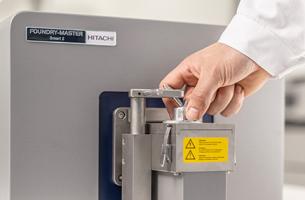
Our Adjcalc software combined with the highly intuitive Hitachi SpArcfire operating system, a foundry can automate the main aspects of melt correction. As soon as a Hitachi OES analyzer shows that the material in the production process has not met the specification, the software can automatically calculate the adjustments needed and recommend a plan of action.
No more calculators and no more excel spreadsheets. Just quick, precise analysis and clear instructions on how to correct the composition of the melt. By accessing the Hitachi High-Tech GRADE Database which has up-to-date data on over 350,000 metal grades, your OES can automatically compare the analysis with the grade specs to ensure your charge corrections get the best results as fast as possible to guarantee melt quality. We offer a free 60-day trial of the GRADE Database.
As well as making all the necessary calculations in a matter of seconds, Adjcalc can help reduce the costs of the charge correction process.
The software calculates and selects the most efficient and cheapest combination of source materials needed to achieve the desired melt specification. This might help you to make better use of your scrap rather than buying in expensive raw materials.
The complexity of manual charge correction calculations leads to significant potential for human error. When dealing with extremely fine margins in a high-volume environment, the smallest error in calculation can create a huge amount of disruption.
By allowing software to handle this part of the process, operators can dramatically reduce the number of charge correction errors. And balancing all the elements in a metal, as opposed to just one, reduces the potential for needing further costly rounds of corrections.
The software is so intuitive and easy to use that years of technical expertise in metallurgy is no longer required to perform a melt correction. One of the goals for our software is to allow even the most technical processes to be completed in a few simple steps. With charge correction no longer a disruptive process demanding significant staff resources, process efficiency and productivity are much easier to maintain.
By combining Adjcalc software with SpArcfire, foundries can take the complexity and uncertainty out of charge correction and ensure materials are produced to the right specification. At Hitachi High-Tech we have been creating solutions that allow foundries to get the best results in the safest and most efficient way possible for over four decades. Harnessing the power of software is the next exciting step for many metal production companies across the world.
For more information on supporting software and how to achieve optimal melt control with OES analysis we offer guides for cast iron and non-ferrous casting.
Download the guide for cast iron melt control Download the guide for non-ferrous casting melt control