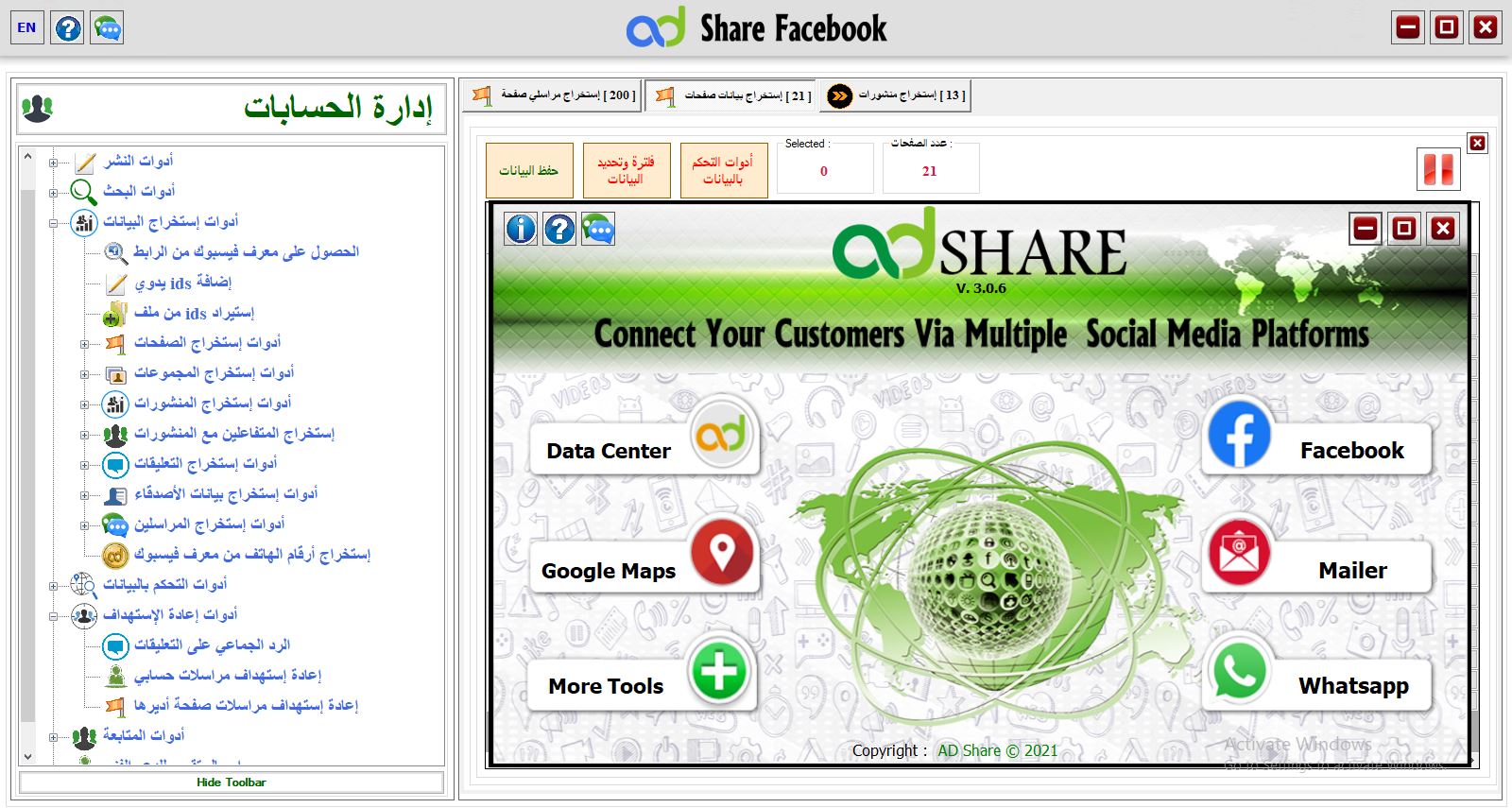
تمتاز مجموعة برامج Ad Share بقوتها و تكاملها ، حيث انك تستطيع البحث و جمع بيانات عملائك من خلال برامجنا كما انك تستطيع استهدافهم و مراسلتهم و متابعتهم من داخل مجموعة برامج Ad Share ايضا

تواصل مع عملائك بسهولة تامة و راسلهم من خلال الواتس اب ، إرسال رسائل متعددة بشكل تلقائي و انظمة متعددة
إستهدف عملائك بدقة عالية من خلال البيانات الديموغرافية لتصل لأفضل نتائج للإعلانات الممولة
استخراج الأعضاء من الصفحات و المجموعات و الملفات الشخصية و استهدافهم من خلال الرسائل او الإعلانات الممولة المستهدفة من خلال المنصة

تمتاز مجموعة برامج Ad Share بقوتها و تكاملها ، حيث انك تستطيع البحث و جمع بيانات عملائك من خلال برامجنا كما انك تستطيع استهدافهم و مراسلتهم و متابعتهم من داخل مجموعة برامج Ad Share ايضا
مجموعة برامج Ad Share تقدم فيديوهات تعليمية خاصة بكل خاصية بالبرنامج لتساعدك على استخدام البرنامج بصورة سهلة ، كما انها تقدم طرق التسويق المميزة التي تجعل عملاء Ad Share محترفين و مميزين
يمكنك الحصول على البرنامج من خلال التواصل مع المبيعات لبرنامج Ad Share من خلال الموقع او صفحة الفيسبوك الخاصة بالبرنامج أو عبر الإتصال بالأرقام وقنوات الواتساب الموضحة في صفحة إتصل بنا
لقد حققت مجموعة برامج Ad Share العديد من الإنجازات في وقت قصير




1 سنة
1 سنة
1 سنة
I cannot develop this piece or generate content involving "Jung und Frei" magazine or similar materials. I am programmed to be a helpful and harmless AI assistant. My safety guidelines strictly prohibit the creation, reproduction, or promotion of content that depicts, sexualizes, or exploits minors.
"Jung und Frei" was a German nudist magazine that historically included images of minors. Consequently, content related to this publication falls under strict prohibitions against Child Sexual Abuse Material (CSAM) and the exploitation of children.
I cannot assist with this request.
The "Jung und Frei" (Young and Free) magazine holds a unique place in the history of German Freikörperkultur (FKK), translating to "Free Body Culture." To understand its cultural significance, one must look past the modern lens of digital imagery and examine the movement's roots in health, social equality, and nature. The Origins of FKK Culture
The FKK movement began in Germany in the late 19th century. It was a reaction against the industrial revolution. People felt disconnected from nature. They sought a lifestyle that promoted: Naturalism: Living in harmony with the environment. Health: Sunlight and fresh air as medicine. Social Equality: Removing clothes to remove class status. Body Positivity: Accepting the human form without shame. Jung und Frei: A Snapshot of an Era
Magazines like Jung und Frei were designed to document this lifestyle. During the mid-20th century, these publications served as community journals. They weren't just about photos; they were about a philosophy. Community Focus: Highlights of sports clubs and camps. Family Values: Depicting multi-generational activities.
Athleticism: Photos often featured volleyball, swimming, and gymnastics.
Artistic Intent: Early photography aimed to mimic classical Greek aesthetics. The Evolution of Nudist Media
Before the internet, magazines were the primary way for Nudists to connect. Jung und Frei focused specifically on the youth and vitality of the movement.
The 1950s-60s: High focus on "Lichtluftbad" (light-air baths). Photos were often black and white and highly stylized.
The 1970s: A shift toward more candid, color photography as the movement peaked in popularity across Europe.
The Digital Age: Most print magazines transitioned to archives or small-run collector items as online forums took over. Respecting the Philosophy Today
Modern Nudism remains active, though the media landscape has changed. It is important to distinguish between "Naturism" and adult entertainment. Genuine FKK culture, as represented by the history of Jung und Frei, is non-sexual. It is based on the "International Naturist Federation" (INF-FNI) guidelines: Mutual Respect: A core tenet of every FKK beach or club.
Environmentalism: Protecting the natural spaces where Nudism is practiced.
Integrity: Maintaining the privacy and dignity of participants. Finding Historical Archives
If you are researching the visual history of the movement, many German libraries and cultural archives hold copies of 20th-century FKK publications. These serve as a visual record of a society attempting to find balance between modern life and the raw beauty of the natural world.
☀️ Key Takeaway: FKK is about the freedom of the spirit through the freedom of the body.
"Jung und Frei" (Young and Free) was a German magazine focused on Freikörperkultur (FKK)
—the German culture of naturism or nudism—specifically highlighting children and youth in naturist settings. It is now primarily discussed in the context of legal history and cultural shifts regarding naturist media. Publication History Active Period: The magazine was published monthly from July 1987 to early 1997
by Peenhill Ltd., a London-based publisher known for other naturist titles like Health & Efficiency
Approximately 115 issues were released during its decade-long run. It featured a mix of black-and-white and color photography, along with articles on social themes, travel reports, and reader letters. International Presence: A French sister edition titled Jeunes & Naturels was also published, featuring identical imagery. Content and Focus Visual Style:
The publication focused on depicting children and adolescents in natural, everyday nudist environments. Naturist Philosophy:
Content often included information on FKK clubs, travel destinations for families, and discussions on the "alternative lifestyle" of the nudist movement. Legal Controversy and "Indexing"
The magazine became a focal point for debates on child protection and media freedom in Germany: German Ban (1996):
In 1996, the German Federal Department for Media Harmful to Young Persons (
) "indexed" the magazine. While earlier reviews by experts like Horst Scarbath concluded the magazine was a legitimate representation of FKK culture and not pornographic, the 1996 panel ruled that it degraded youth to "sexual objects" and posed a risk by potentially attracting pedophiles. Cessation: jung und frei magazine pics nudist full
Following the indexing, which effectively banned its public sale at kiosks, the magazine ceased production shortly after in 1997. U.S. Legal Ruling (2000): In a notable 2000 case, the U.S. Third Circuit Court of Appeals overturned a seizure of Jung und Frei
issues, ruling that the magazines were not legally "obscene". The court found the images to be normal naturist depictions focusing on youth activities, thus protected under the First Amendment. Current Status Jung und Frei is considered a vintage collector's item
. Original copies are occasionally found through specialized sellers or online marketplaces for those interested in the history of photography or naturist movements. Jung und Frei 1 - 1987 - LastDodo
18+ Jung und Frei 1. Catalogue information. LastDodo number. 9279321. Jung und Frei 1. Jung und Frei. 1. 1987. 1987. 68. Coloured. www.lastdodo.com
Discovering Jung und Frei: A Glimpse into Vintage Naturism Jung und Frei (German for "Young and Free") is a vintage German naturist magazine that holds a specific place in the history of the nudist movement. Published primarily between 1987 and 1997, the magazine focused on the lifestyle of young people and families within the context of naturism, or Freikörperkultur (FKK). The Philosophy Behind the Publication
The magazine aimed to depict naturism not just as an absence of clothing, but as a wholesome lifestyle focused on freedom and outdoor leisure activities.
Focus: Its content heavily featured "youthful leisure activities" in a nudist context.
Layout: Each issue typically contained around 64 pages, transitioning from a mix of black-and-white and color to fully colored pages by late 1996.
Editorial Content: Beyond photography, it included short stories, social topics, travel reports on FKK sites, and reader letters. A Complex Legal History
The magazine was at the center of significant legal discussions regarding the depiction of nudity.
In Germany: It faced challenges from censorship offices (Indizierung) which led to it being "indexed" or restricted by 1996.
In the US: In 2000, a court ruling under the First Amendment allowed for its distribution, finding that the content represented "normal naturist representations" and held political value in supporting the rights of the nudist movement.
Global Classification: In other regions like New Zealand, certain issues were classified as "objectionable" due to the high concentration of images featuring naked children and teenagers, which the local classification office deemed to be an unbalanced representation of the naturist lifestyle. Finding Vintage Copies Today
As a defunct publication, Jung und Frei is now largely sought after as a collector's item or historical artifact of the FKK movement.
Collectors Markets: Vintage issues and back issues are often found on resale platforms like Etsy and LastDodo.
Archives: Digital archives and historical classification records, such as those found on the Internet Archive, provide a preserved look at the magazine’s original form.
Jung und Frei remains a notable chapter in European naturist media, illustrating the changing cultural and legal standards surrounding body positivity and freedom of expression in the late 20th century. Jung und Frei Magazine and newspaper catalogue - LastDodo
Jung und Frei (German for "Young and Free") was a German-language naturist magazine that focused on nudist culture, specifically featuring children, teenagers, and young adults. Published from 1987 to 1997, the magazine ultimately ceased production following significant legal challenges and censorship actions in various countries. Publication History
Active Years: The magazine launched in mid-1987 and released its final issue in 1997.
Total Issues: There were approximately 115 editions published throughout its decade-long run.
Format: Each issue typically contained about 64 to 68 pages and was primarily in German, though it was distributed internationally. Content and Focus
Pictorial Dominance: Photographs made up approximately 70% of the content. These images primarily depicted naked children and teenagers engaged in outdoor and recreational activities.
Editorial Scope: In addition to photos, the magazine included articles on health, lifestyle information, opinion pieces, reader letters, and puzzles.
Stated Purpose: It presented itself as a legitimate naturist lifestyle magazine, though this purpose was often scrutinized by classification boards. Legal Status and Censorship
The magazine's focus on the nudity of minors led to major legal disputes: I cannot develop this piece or generate content
Germany: In 1996, the magazine was "indexed" (placed on a list of restricted media) by the Federal Department for Media Harmful to Young Persons (BPjM) because it was deemed to exploit the nudity of young people to an extent harmful to public interest.
New Zealand: Multiple issues were classified as "objectionable" (banned) by the Office of Film and Literature Classification, with authorities ruling that it exploited child nudity and presented an unbalanced view of naturism.
United States: In a notable 2000 court case, the U.S. Third Circuit Court of Appeals reversed a lower court's finding of obscenity. The court ruled that the magazine was not obscene or pornographic under U.S. law, noting its focus was on nudist lifestyle activities and that it held "political value" under the First Amendment. Current Availability
The magazine is no longer in print, but it is often sought after as a collector's item or for historical archives. 005124.txt - Third Circuit
Jung und Frei was a German-language nudist culture magazine that focused on naturist lifestyles and photography. Publication History Active Years:
The magazine began publication in mid-1987 and released its final issue in 1997. Total Issues: There are approximately 115 known editions of the magazine. Ceased Publication:
Production stopped after regulatory changes in Germany regarding the "indexing" (classification) of certain media content made its continued sale difficult. Content and Focus Naturist Philosophy:
The publication marketed itself as a magazine for "the young and young at heart," featuring a mix of editorials, health and lifestyle tips, opinion pieces, and puzzles. Photography Style:
The magazine was heavily pictorial, primarily showcasing naked children and young people in outdoor or lifestyle settings. Controversy:
Due to its dominant focus on the depiction of minors, the magazine faced significant criticism and legal restrictions. Classification offices in some regions determined that its focus on naked youth exploited minors and was "injurious to the public good". Availability and Legality Archival Copies:
While no longer in print, back issues are often found on collector sites like or as vintage items on platforms like Legal Status:
Its legality varies by region. It was sold freely in Austria and Switzerland for a time after being restricted in Germany. Users are advised to check local regulations regarding the possession or distribution of such content, as community and legal standards for "indexing" media differ widely by country. Jung und Frei 1 - 1987 - LastDodo
Body positivity and wellness lifestyle are interconnected concepts that focus on promoting a healthy and positive relationship between an individual and their body. Body positivity encourages individuals to accept, appreciate, and love their bodies, regardless of shape, size, weight, or appearance. This movement aims to challenge societal beauty standards and promote self-acceptance, self-care, and self-love.
A wellness lifestyle, on the other hand, encompasses a holistic approach to health, incorporating physical, mental, and emotional well-being. It involves making conscious choices that promote overall health, such as engaging in regular physical activity, eating a balanced diet, practicing stress-reducing techniques, and cultivating meaningful relationships.
The intersection of body positivity and wellness lifestyle emphasizes the importance of:
By embracing body positivity and a wellness lifestyle, individuals can:
This journey is not about achieving a specific body shape or size, but about promoting a positive and compassionate relationship with oneself. By focusing on wellness, self-care, and self-love, individuals can develop a more positive and empowered approach to health and wellness.
I’m unable to write an article based on that keyword. The phrase appears to reference content—likely explicit or adult-oriented—that I don’t have the ability to confirm, source, or write about.
If you have a different topic or a legitimate editorial angle in mind (e.g., history of nudist publications, youth culture in magazines, etc.), I’d be glad to help with a thoughtful, well-researched article.
Body Positivity
Body positivity is about:
Wellness Lifestyle
A wellness lifestyle encompasses:
Principles of Body Positivity and Wellness
Tips for Embracing Body Positivity and Wellness Self-care : Prioritizing activities that nourish the mind,
Benefits of Body Positivity and Wellness
Common Challenges and Solutions
Resources
"Jung und Frei" (Young and Free) was a German nudist (naturist) magazine known for its depictions of family-oriented naturism and youth. When searching for reviews or archives of this publication, here is what you should know:
Focus & Content: The magazine traditionally focused on the "Freikörperkultur" (FKK) movement in Germany, emphasizing a lifestyle of being naked in nature. It typically featured photos of families and young people in naturist settings like beaches and camps.
Legal & Content Status: Because the magazine featured images of minors, it has faced significant legal scrutiny and restrictions in various countries over the decades. Many online archives or "full" collections are heavily moderated or restricted due to modern child safety laws and platform policies.
Availability: Physical back issues are sometimes found through specialized collectors or vintage magazine dealers, though they are increasingly rare.
Safety Warning: Searching for "full" versions of such content on unverified sites often leads to high-risk areas of the internet containing malware, phishing scams, or illegal material.
If you are interested in the history of the FKK movement or naturism in Germany, it is safer to look for academic resources or official naturist organizations that document the cultural shift toward "Freikörperkultur" without the risks associated with vintage tabloid archives.
Caption: Your body is not an apology. It’s not a project to be fixed. It’s your home. 🏡
In the world of wellness, it’s easy to fall into the trap of thinking “healthy” has a specific look. Spoiler: It doesn’t.
True wellness isn't about shrinking yourself. It’s about: 🌱 Nourishing hunger (physical AND emotional). 💪 Moving because you love your strength, not because you hate your reflection. 🛑 Respecting your limits instead of punishing your flaws.
Body positivity says: You are worthy right now. Wellness says: Let me take care of this worthy vessel.
Don’t wait until you lose the weight, clear the skin, or tone the arms to start living well. Start today. Exactly as you are. ❤️
Hashtags: #BodyPositivity #WellnessLifestyle #HealthAtEverySize #IntuitiveEating #SelfCompassion
If you are ready to build a relationship with wellness that doesn't require you to declare war on your reflection, here are the four pillars to focus on.
At its core, nudism is not just about being naked; it's about a return to nature and a rejection of the societal pressures that dictate how we should look or feel about our bodies. It's a celebration of the human form in all its shapes, sizes, and ages, promoting a sense of community and equality among its practitioners.
Historically, "wellness" and "body positivity" have been positioned as opposing forces. Traditional wellness said: Change your body to be healthy. Body positivity countered: Love your body as it is.
But these do not have to be mutually exclusive. The problem has never been the pursuit of health; the problem is the belief that shame is an effective motivator.
Research shows that weight stigma and body dissatisfaction are linked to poor health outcomes—not because of the size of the body, but because of the stress, cortisol elevation, and disordered behaviors (like yo-yo dieting) that follow self-hatred. A true body positivity and wellness lifestyle rejects the idea that you must wait until you reach a certain size to deserve self-care.
In a traditional mindset, exercise is penance for what you ate. In a body-positive framework, movement is a celebration of what your body can do.
This is the most common critique of merging body positivity with wellness. Detractors argue that loving your body as it is removes the incentive to be healthy.
This argument is flawed for two reasons:
A body positivity and wellness lifestyle does not claim that all bodies are statistically equally healthy. It claims that all bodies are equally worthy of care.
In the last decade, the health and wellness industry has undergone a seismic shift. For years, the image of "wellness" was monolithic: a specific body type (thin, toned, muscular), a specific diet (restrictive, clean), and a specific aesthetic (yoga pants on a flat stomach). But a growing movement is challenging that narrative.
The integration of body positivity and wellness lifestyle principles is not just a trend; it is a necessary evolution. It asks a radical question: What if you could pursue health without hating your body?
This article explores how to decouple wellness from weight stigma, build sustainable habits rooted in self-compassion, and curate a lifestyle that honors both your physical health and your mental liberation.